
The Participation Debt: Why Good Intentions Aren't Enough for Audience Engagement
Last month I stood on stage at Engage 2026 and told a room full of journalists something they didn't love hearing.
Care is not a mindset. It's a workflow.
Every newsroom I've ever worked with genuinely wants to listen to its audience. They run call-outs. They ask for photos, opinions, stories, tips. They mean it.
But asking is the easy part. The hard part starts the moment someone actually responds.
What is the participation debt?
The participation debt is the quiet obligation a newsroom creates every time it asks its audience for something. Not an obligation to publish every contribution, or to agree with it. An obligation to do something responsible with the effort someone just handed over.
Most newsrooms don't default on this debt on purpose. They default on it by accident, because nobody designed the workflow for what happens after the ask. A form collects 700 responses and three get published. A brilliant reader story becomes a great article, and the reader who told it never finds out. A spreadsheet fills up and nobody opens it again.
None of that is bad journalism. It's incomplete infrastructure.
One chain, six places it can quietly break
Underneath every call-out is the same simple chain: ask, receive, review, use, acknowledge, return.
It only takes one weak link to turn a good idea into wasted effort:
Ask, receive, and then nothing. The spreadsheet nobody opens again.
Ask, get 700 responses, publish three. That's 693 people who took the time to respond and got silence back.
Ask, receive, learn something genuinely useful, write a great article, and the audience never finds out they were part of it. The journalism is good. The relationship is still incomplete.
Each of these feels like a small oversight in the moment. Add them up across a year of call-outs and you get an audience that's quietly learned not to bother next time.
The framework: ASK, CARE, SHOW, RETURN
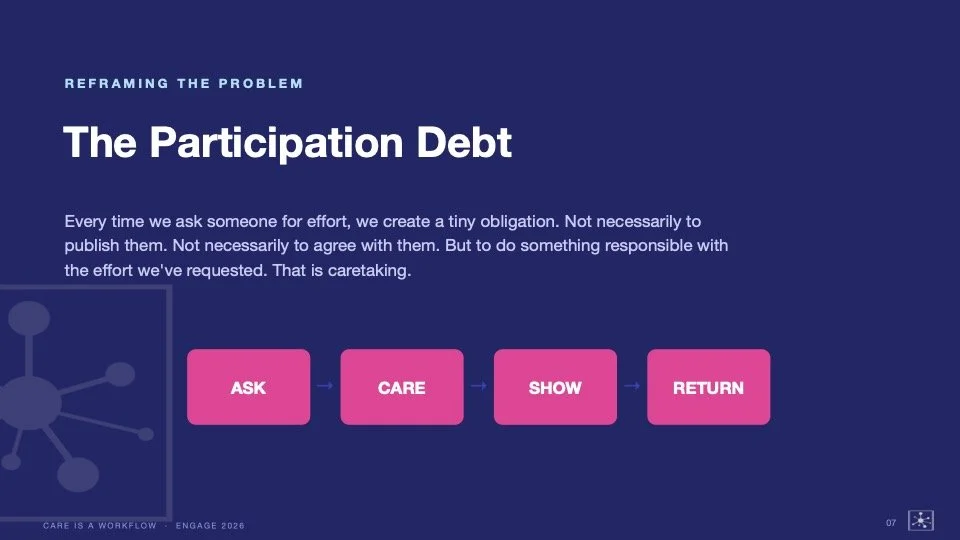
The ASK, CARE, SHOW, RETURN framework for audience participation
The fix isn't asking less. It's building the rest of the chain on purpose. Here's the framework I shared at Engage 2026, and the one we use with newsrooms every day at Contribly.
ASK: is there a reason for participation? Don't start with "how do we get readers to engage." Start with "why does the journalism get better because they took part." Tell people what you're asking for, why, and roughly how it'll be used. That one sentence of honesty does more for response quality than any incentive.
CARE: can we responsibly handle what comes back? Before a call-out goes live, ask what happens if a thousand people answer. Who reads it. Who moderates it. How is anything sensitive handled. What happens to the good stuff that doesn't make the final article. This is where workflow and technology genuinely earn their keep, not to replace editorial judgement, but to stop it from drowning.
SHOW: can people see that participation mattered? This is most newsrooms' strongest instinct already. Publish contributions. Quote people. Visualise what came in. The part that's easy to miss: acknowledgement can scale even when individual replies can't. You don't need to personally email two thousand people to close the loop. You need them to be able to see, clearly, that something happened with what they gave you.
RETURN: what happens next? Don't treat every call-out as its own island. "You told us X, so we looked into Y." "Six hundred of you said this last month." This is the step that turns a transaction into a relationship, and it's the one most engagement strategies skip entirely.
What this looks like in practice
Two examples from our work with newsrooms make the difference concrete.
Every autumn, the Dutch local title gooieneemlander.nl ran a mushroom photo competition. Readers emailed in their best shots, the newsroom picked a handful of winners, and that was it. Good participation, capped by how much the team could manually handle.
They changed nothing about the ask. They changed everything about what came after, publishing every contribution in a live gallery readers could browse, like, and share. The result: 5x more submissions, 6x more page views than the year before, and 4x more time on page than an average article. People weren't just entering a competition. They were exploring a community.
At GVA.be, the shift wasn't about volume, it was about habit. Five to seven debate call-outs a week, on whatever the day brings, generating 3 to 10x more time on page than a standard article. Because discussions only stay open for a limited time, readers come back specifically to see if they were published and what everyone else said: a 57% return rate. Across Contribly's newsroom clients as a whole, the average return rate for people who've had something published sits at roughly 20%, so GVA's habit-built debates are running well ahead of the norm.
As GVA's Online News Manager Dominick put it: "We increased the value of our articles fivefold because readers wanted to see if their answer was approved, and what others were saying."
There's a quieter pattern behind both of these. When someone has just taken part in something, they're unusually open to what happens next. Across the newsrooms we work with, around a fifth of people who contribute also opt into a newsletter on the spot. At the San Francisco Chronicle, newsletter sign-up on a participation page ran at 2.75%, against 0.01% on an average article. Participation doesn't just produce content. It produces a moment of trust that's easy to build on and very easy to waste.
The Care Test
Before your next call-out goes live, run it through four questions:
Why are we asking? What will participation actually change?
Can we care for the response? What happens if this succeeds beyond expectations?
How will people know they mattered?
What reason are we giving them to come back?
If you can't answer questions two through four, you're probably not ready to ask question one.
A quick word on CGC versus UGC
You'll notice we don't say UGC here. That's deliberate, not a style choice.
User-generated content is the social media version: unstructured, sent into a third-party platform you don't own, with none of the relationship attached. Community-generated content (CGC) is sent directly to the newsroom, arrives with first-party data attached, and starts a real relationship on the publisher's own platform. Same instinct to involve the audience. Completely different asset at the end of it.
The participation debt framework only really works when you're thinking in terms of CGC. UGC, by definition, isn't yours to care for in the first place.
Who we publish with
Audience trust isn't something readers decide to hand over. It's built in hundreds of small interactions: you asked, I answered, you showed me it mattered, and then you came back. That's a relationship, not a campaign.
Every time someone contributes and hears nothing back, we're quietly training them not to bother next time. The opposite is just as true. Newsrooms that close the loop, consistently, build audiences that keep showing up on their own terms, not because an algorithm sent them.
This is the thinking behind the talk I gave at Engage 2026, "Care Is a Workflow: Why Good Intentions Fail Without Participation Infrastructure." If you want the fuller argument for why this is becoming core publishing infrastructure rather than a nice-to-have, I wrote about it for WAN-IFRA: Why audience participation is becoming core publishing infrastructure.
If you're working through what this could look like for your own newsroom, get in touch or book a look at how Contribly's Hub handles the CARE and SHOW steps without adding to your team's workload.
FAQ
What is the participation debt? The participation debt is the obligation a newsroom takes on every time it asks its audience to contribute something. It isn't a promise to publish everything, but a responsibility to handle what comes back thoughtfully, whether that's through moderation, acknowledgement, or follow-up.
What is the ASK, CARE, SHOW, RETURN framework? It's a four-step model for designing audience participation as a repeatable editorial process rather than a one-off campaign: ask with a clear reason, care for what comes back responsibly, show contributors their input mattered, and return to the community over time.
What's the difference between CGC and UGC? UGC (user-generated content) typically lives on third-party platforms with no direct relationship to the publisher. CGC (community-generated content) is collected directly by the newsroom, comes with first-party data, and supports an ongoing relationship on the publisher's own platform.
Why do reader call-outs often fail to build lasting engagement? Most call-outs break down after the ask, not during it. Contributions get collected but not reviewed at scale, published selectively without explanation, or never acknowledged. Readers who don't see the outcome of their contribution are unlikely to participate again.