
How Publishers Can Build Reader Habits with Community-Generated Content and Push Notifications
Please note our Content Disclaimer in relation to blog posts.
How do you bring readers back when traffic is becoming less predictable?
That was the central question behind our recent webinar with PushPushGo: How publishers can build reader habits.
Because let’s be honest, relying on search, social and platform algorithms is feeling less like a strategy and more like a very stressful game of roulette.
Search traffic is declining. Social referrals are becoming less reliable. Google Discover can feel like a black box. And audiences are increasingly following individual creators, personalities and niche communities rather than automatically returning to publisher homepages.
So the challenge for publishers is no longer just:
“How do we get people to click?”
It is:
How do we give readers a reason to come back on purpose?
The answer sits in the space between participation, direct relationships and timely reminders.
In other words: community-generated content plus smart push notifications.
1. Reader habits are built through participation, not one-off traffic
One of the biggest themes from the webinar was that publishers need to move beyond passive consumption.
Readers do not only want to read about their community. They want to see themselves, their experiences and people like them reflected in the coverage.
That is where community-generated content, or CGC, comes in.
Unlike traditional UGC, which often lives randomly on social media, CGC is intentionally invited by the publisher. It could be:
Photo call-outs
Reader stories
Polls with optional comments
Local debates
Video questions
Interactive maps
Event submissions
Community recommendations
The important difference is that the publisher leads the conversation.
Instead of publishing an article and waiting for readers to react somewhere else, the newsroom asks a specific question and invites readers to take part directly on its own platform.
That shift matters.
Because when readers contribute, they are no longer just consuming your journalism. They are participating in it.
2. “If you don’t ask, you don’t get”
One simple but powerful lesson from the webinar was this:
Readers often will contribute — but only if you ask them properly.
Francesca shared the example of a Dutch local publisher that asked readers to send in photos of the first snow of the year.
The result?
More than 500 photos in one day.
Most people’s instinct when it snows is to send a picture to friends, family or social media. They do not automatically think, “I’ll send this to my local news brand.”
But when the publisher asked, readers responded.
That is the point.
Audience participation does not happen by accident. It needs to be designed into the content strategy.
3. Do not waste reader engagement
One of the strongest examples from the webinar was the mushroom photo call-out.
Yes. Mushrooms. Stay with us…
A local publisher in the Netherlands had traditionally asked readers to send mushroom photos by email, then selected a handful to publish.
But if 100 readers send in photos and only five are published, that means 95 people tried to participate and saw nothing come from it.
That is wasted engagement.
Those readers took the time to connect with the newsroom, but the value exchange was incomplete.
When the publisher changed the workflow and used Contribly to publish all approved submissions in a live gallery, the results changed dramatically:
5x more submissions
6x more page views
4x more time spent on page
More than 7,500 likes and shares

The lesson is clear:
When readers can see that participation leads somewhere, they are more likely to take part again.
That is how habits start.
4. Consistency beats one-off creativity
Reader habits are not built through one amazing campaign.
They are built through repetition.
One example shared in the webinar was GVA in Belgium, which uses daily debates to bring readers back regularly.
The format works because it is predictable. Readers know there will be a new debate. They know when it closes. They know their responses will be published. They know there is a reason to return.
That consistency creates a rhythm.
It could be:
A daily debate
A weekly reader question
A monthly photo challenge
A recurring local poll
A journalist-led Q&A
A seasonal community gallery
A regular “readers recommend” format
The specific format matters less than the habit it creates.
The most important thing is that readers understand:
“This happens here. I can take part. And something will come from it.”
5. Participation is a natural moment to build direct relationships
Another major learning was that participation creates a powerful moment for conversion.
When someone has just shared a photo, voted in a poll, submitted a story or joined a debate, they are emotionally invested.
That is the perfect moment to ask them to take the next step.
For example:
“Want to know when your photo is published?”
“Get tomorrow’s debate in your inbox.”
“Be notified when readers respond.”
“Follow this topic.”
This is where CGC and push notifications work beautifully together.
Participation creates the reason to care.
Push notifications create the mechanism to return.
6. Push notifications should feel useful, not annoying
PushPushGo shared a clear warning during the webinar:
Do not blast everyone with everything.
That is how publishers lose trust.
The most effective push strategies are targeted, timely and relevant.
That means segmenting readers by:
Location
Topic interest
Reader type
Behaviour
Previous participation
Subscription status
For example, a reader in London does not need a traffic alert from Warsaw. A football fan may not want celebrity updates. Someone who contributed to a local debate may be much more interested in the follow-up story than a generic homepage prompt.
Relevance is what makes push notifications valuable.
Without relevance, they become noise.
7. The reader’s lock screen is becoming a new homepage
One of the strongest lines from the webinar was this:
Think of the reader’s lock screen as your new homepage.
That is where attention is.
A well-timed push notification can bring readers back at the exact moment when they are most likely to care.
But the goal is not just to send more notifications.
The goal is to create a loop:
Invite readers to participate
Capture their contribution or response
Notify them when something happens
Bring them back to see the result
Guide them into the next relevant action
Use the data to understand what to ask next
That is how engagement becomes a habit rather than a lucky accident.
8. The best engagement strategies connect editorial, audience and data
Community-generated content is not just “nice engagement”.
It gives newsrooms valuable audience insight.
Every contribution can help editors understand:
What topics readers care about
Which formats drive the most participation
Which locations are responding
What experiences readers are sharing
What follow-up questions should be asked
Which stories deserve deeper coverage
This is where participation becomes more than a content format.
It becomes audience intelligence.
And when that data is used properly, it helps newsrooms make better editorial decisions, build stronger relationships and create more relevant reader experiences.
9. Building reader habits requires a maturity shift
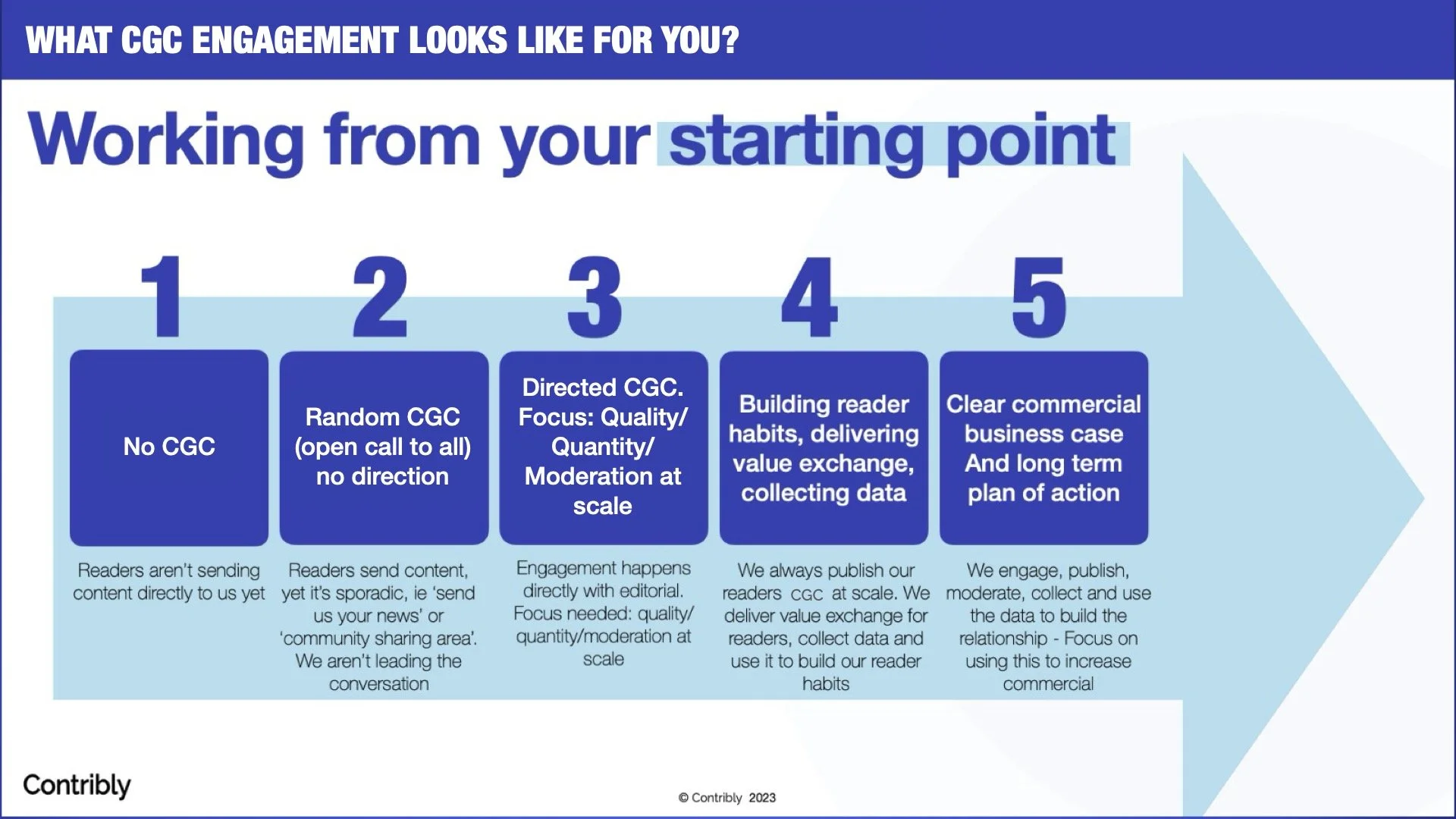
During the webinar, both Contribly and PushPushGo shared maturity models for publishers.
Most organisations sit somewhere between:
No direct reader participation
Random contributions from social or email
Structured call-outs
Repeat participation formats
Fully integrated engagement loops with clear business value
The goal is not to jump from zero to perfect overnight.
The goal is to move from random engagement to intentional engagement.
From “send us your news” to “here is today’s question”.
From “we got some photos” to “we published a live gallery and invited people back”.
From “we sent a push” to “we notified the right reader at the right moment”.
10. The future of audience engagement is owned, direct and participatory
The biggest takeaway from the webinar was simple:
Publishers need to stop depending entirely on platforms to bring audiences back.
Search and social still matter, of course.
But they cannot be the whole strategy.
The publishers who build stronger habits will be the ones who give readers a reason to belong, participate and return directly.
That means creating regular opportunities for readers to contribute.
It means publishing and acknowledging those contributions.
It means using push notifications, newsletters and on-site messaging to bring readers back at the right moment.
And it means treating participation as part of the editorial and audience strategy — not as an afterthought.
Because reader habits are not built by accident.
They are built through repeated moments of value.
Want to build stronger reader habits?
Contribly helps publishers create reader call-outs, collect and moderate community-generated content, publish contributions instantly, and understand what audiences are telling them.
If you want to explore how reader participation could support your engagement, loyalty or newsletter strategy, we’d be happy to chat.
Explore Contribly or book a strategy session.